
CHANGE NOW, ARCHITECTURE LATER!
a practice-based exploration of the controversies between university, profession and society that underlie becoming an architect in Climate Breakdown
Supervisor: Eike Roswag-Klinge, TU Berlin
Second Assessor: Prof. Jane Anderson, Oxford Brookes University
Chair of Commission: Prof Nanni Grau, TU Berlin
Crabbe, Matthew, ‘Change Now, Architecture Later! — A Practice-Based Exploration of the Controversies between University, Profession and Society That Underlie Becoming an Architect in Climate Breakdown’ (Doctoral Thesis, Technische Universität Berlin, 2025) https://depositonce.tu-berlin.de/handle/11303/25806
All contents © Matthew Crabbe
Matt’s PhD Dissertation “Change Now Architecture Later!” investigates how Climate Breakdown shapes the transition of a group of architecture graduates from university into practice as they confront the structural, ecological and social crises that underlie their emerging identity as architects.
Full PDF (via DepositOnce)
Becoming an architect has always required graduates to bridge a “practice gap” — the disconnect between the idealised expectations of the profession cultivated by universities, the architectural press and public perception, and the realities of everyday architectural labour. Today, this gap is widening as graduates enter a professional discourse defined by rising tensions, shifting narratives and increasingly visible contradictions amplified by the reality of Climate Breakdown. This context challenges the structures, conditions and identities of practice while reordering architecture’s past, present and future. These dynamics are transforming how the next generation understands the discipline and their agency within it. This thesis therefore asks: How wide is the gap between how graduates want a career in architecture to be, and the reality they encounter? How do the conflicting demands of university, profession and society create this gap? And, how does Climate Breakdown necessitate a fresh appraisal of these already fraught relationships?
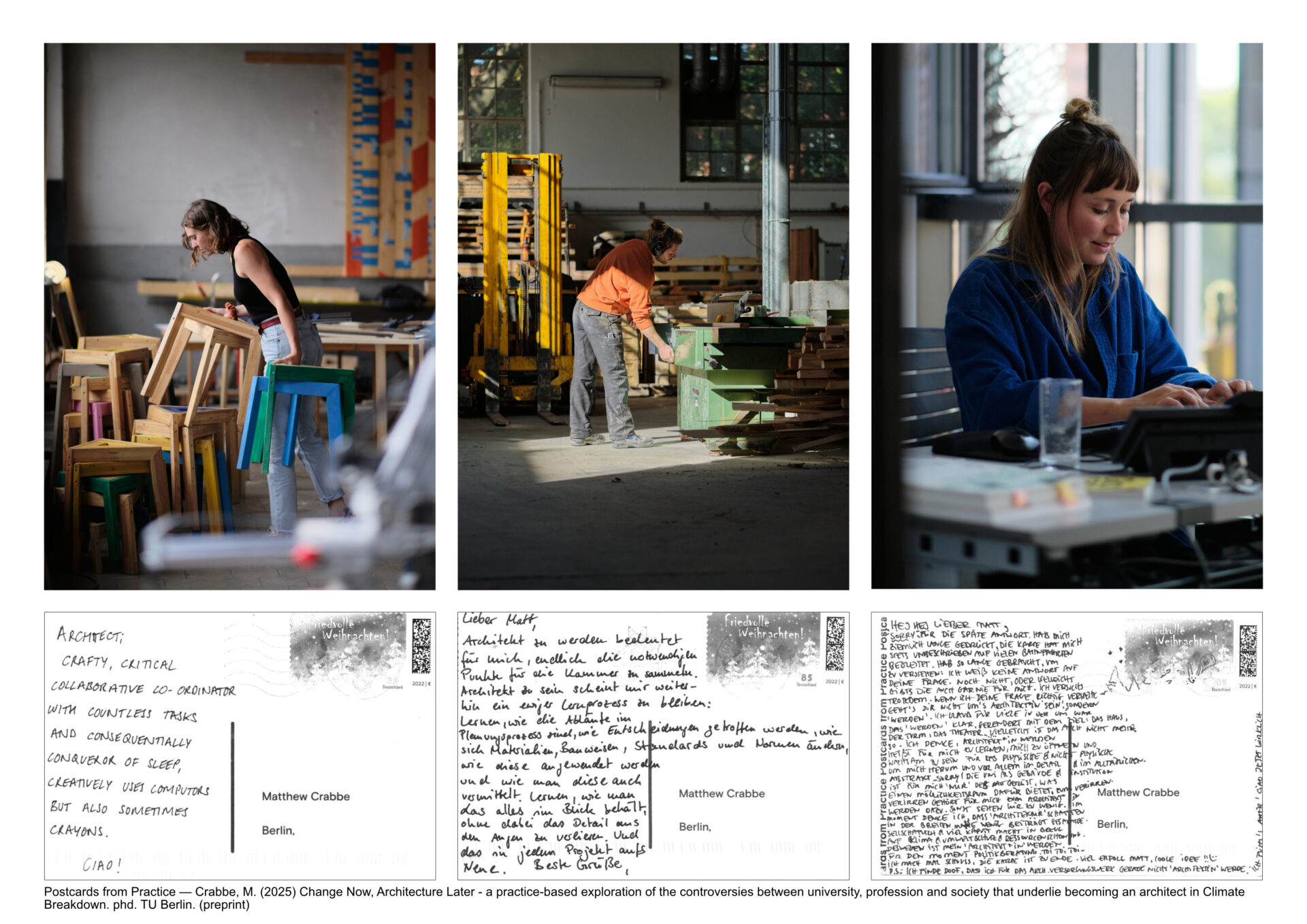
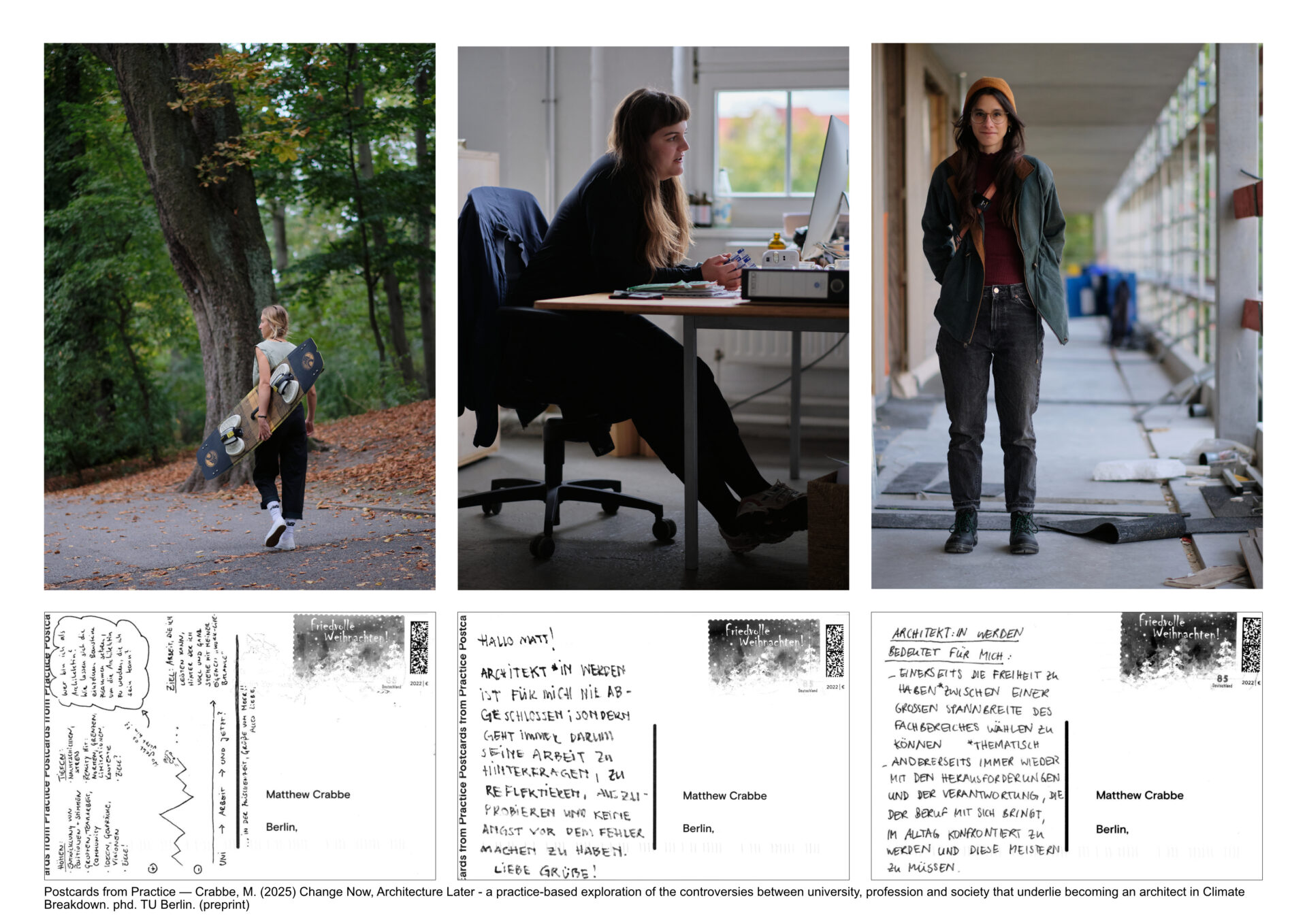
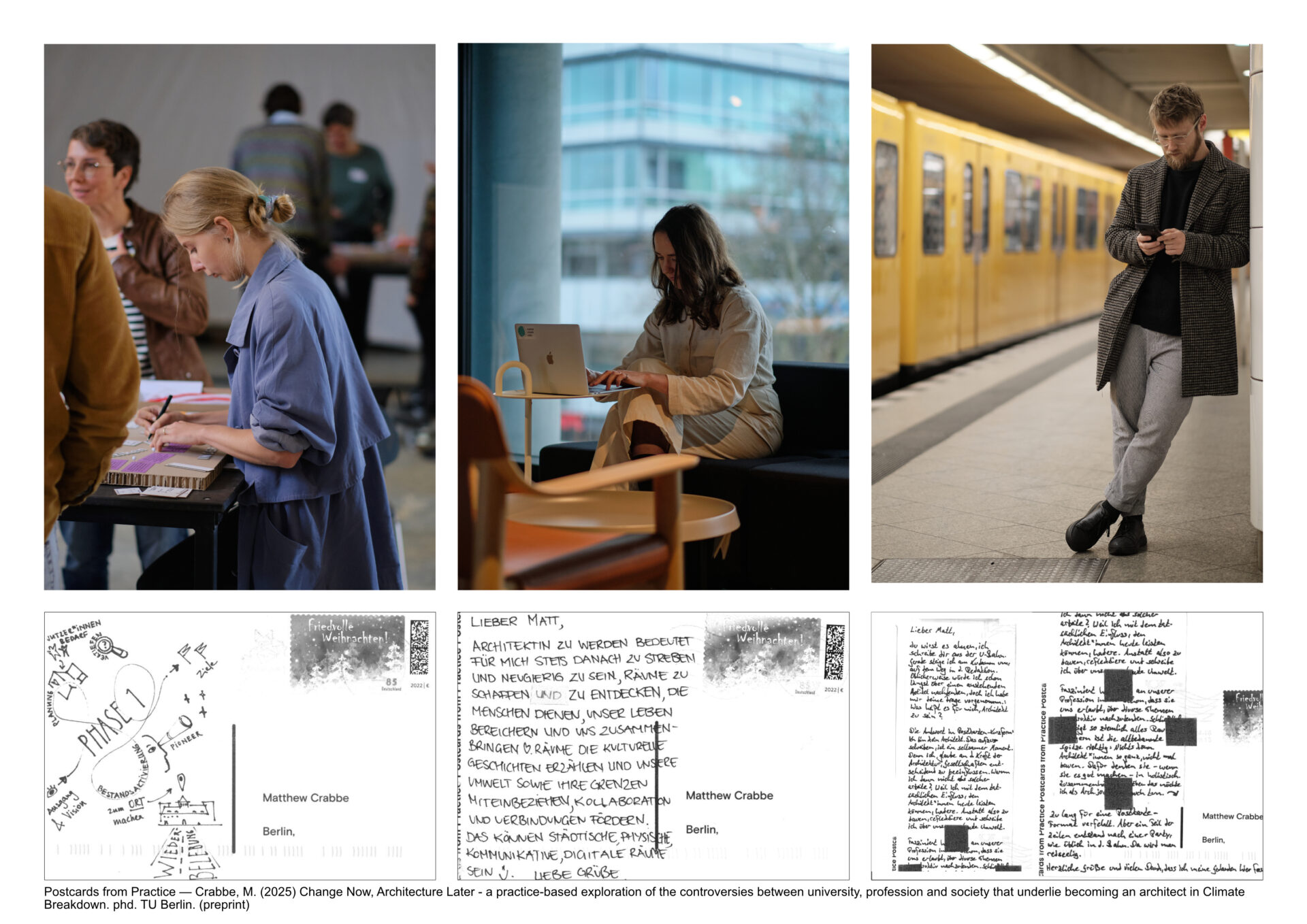
The longitudinal, practice-based study follows nine architecture graduates in the first years after completing their studies at the Technische Universität Berlin. Their trajectories represent diverse professional and para-professional contexts, including architecture offices, collectives, the civil service, journalism and start-ups. The research design alternates between “Chapters,” which develop theoretical and methodological frameworks, and “Tasks,” which operationalise these as practice-based research through interviews, portrait photography and narrative inquiry. These hybrid methods reveal the tacit assumptions, motivations and agendas that shape how graduates make sense of architecture in relation to their identity and personal ethical framework of life-politics
The study interprets the practice gap as a dynamic field in which graduates negotiate their identity as architects between university and practice. Examining this process exposes controversies surrounding climate, social responsibility, labour conditions and generational attitudes to work that increasingly lead graduates to question their motivations to practice architecture. For some, confronting these contradictions means distancing themselves from the profession — temporarily or permanently — in pursuit of work that aligns more closely with their ethical, social and ecological values.
The investigation shows how Climate Breakdown provides a critical lens through which graduates examine architecture’s structural entanglements with extractive and exploitative modes of thinking and doing. It highlights the difficulty those in non-traditional careers have understanding themselves as architects beyond the constraints of the legally protected professional title. However, especially this group’s transversal competencies, such as determination, adaptability and critical reflection, could broaden the profession’s knowledge base and diversity. The thesis argues that recognising and integrating these alternative perspectives is essential to the profession’s renewal in the face of ecological and social crises. Moreover, establishing new forms of architectural labour and identity that are both ethical and sustainable is crucial to overcoming the enduringly problematic “job/calling” binary and strengthening the profession’s legitimacy — both in the eyes of its own practitioners and of the society it serves.
Key Literature
- Barosio, M. et al. (2024) Architecture’s afterlife: the multisector impact of an architecture degree. London New York: Routledge.
- Cuff, D. (1992) Architecture: the story of practice. 2. print. Cambridge, Mass. u.a.: MIT Press.
- Deamer, P. (2020) Architecture and Labor. Routledge.
- Giddens, A. (1991) Modernity and self-identity: self and society in the late modern age. Reprint. Cambridge: Polity Press.
- Harriss, H., Hyde, R. and Marcaccio, R. (eds) (2020) Architects after architecture: alternative pathways for practice. New York, NY: Routledge.
- Hartmann, K. (2022) Black Turtleneck, Round Glasses: Expanding Planning Culture Perspectives. JOVIS. Available at: https://doi.org/10.1515/9783868599893.
- James, S. (2017) Making a Living, Making a Life: Work, Meaning and Self-Identity. London: Routledge. Available at: https://doi.org/10.4324/9781315593241.
- Latour, B. (2007) Reassembling the social: an introduction to Actor-Network-Theory. 1. publ. in pbk. Oxford: Oxford Univ. Press (Clarendon lectures in management studies).
- Samuel, F. (2018) Why architects matter: evidencing and communicating the value of architects. New York: Routledge.
- Starker, V. and Hoppe, J. (2024) New Work in der Architektur. Rossberg. Available at: https://rossberg-verlag.de/rossberg (Accessed: 29 January 2024).
- Terkel, S. (ed.) (1977) Working: people talk about what they do all day and how they feel about what they do. Harmondsworth: Penguin Books (A Peregrine book).
- Ziemer, G. (2013) Komplizenschaft: neue Perspektiven auf Kollektivität. Bielefeld: Transcript (X-Texte).